
Brinlee Miles watched her husband step toward the driveway in Utah, knowing she could not accompany him into the exam room.
Ryan had an alarming family history of skin cancer, and the persistent worry of a missed lesion haunted her thoughts whenever he scheduled routine clinical visits.

A felt-tip marker was her only shield.
Before he walked out the door, she took a dark pen and traced firm circles around six individual spots that troubled her the most.
Most people would hesitate before turning a spouse into a marked canvas, but her instinct to protect his health outweighed every awkward social convention.
Nobody knew how the clinic would react.
The young wife documented the unusual strategy on social media, captioning the footage, “This is how I sent my husband to the dermatologist.”
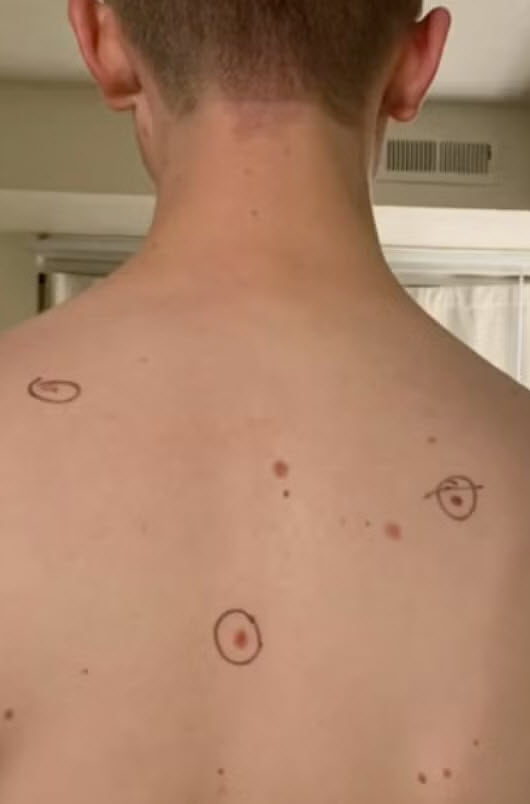
Ryan arrived at the office, removed his shirt, and stood before the specialist with dark circles ringing the moles across his back and chest.
Medical professionals might easily have taken offense at such guidance, yet this practitioner met the situation with humor instead of anger.
The doctor answered in ink.
When he walked back through their front door, he was holding an evaluation sheet and grinning broadly as he uncovered his marked torso.
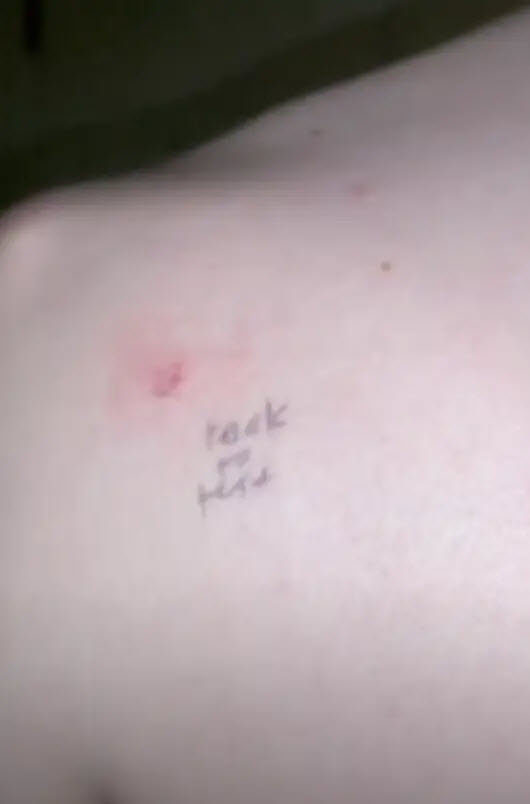
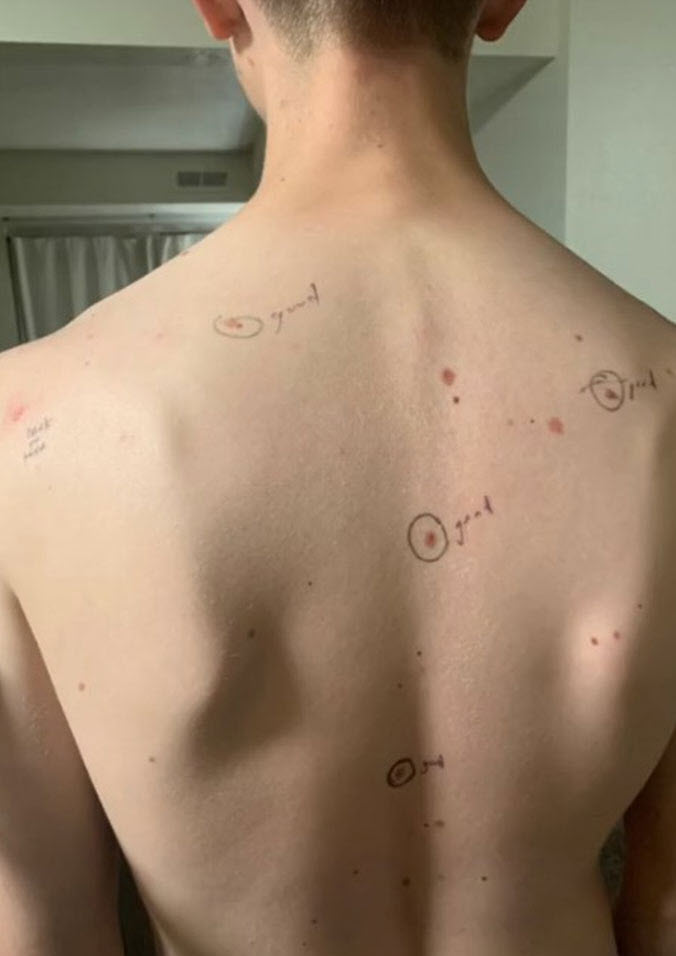
Beside every single circle Brinlee had drawn, the specialist had jotted comprehensive medical notations onto the man’s skin, categorizing each spot as either entirely healthy or requiring testing.
Capturing the hilarious result on camera for their growing digital audience, she recorded his skin, posting, “And this is how she sent him back.”
A casual clip quickly became an international sensation.
The video exploded across TikTok, gathering over eleven million views alongside thousands of comments praising the couple and the doctor.
Yet behind the lighthearted online reaction lay genuine clinical concern, because the doctor had not simply joked around and sent Ryan home without care.
Out of the six moles circled with ink, two raised enough suspicion during the careful clinical examination to warrant an immediate surgical biopsy.
Playful ink marks suddenly carried life-altering weight.
Days later, the couple returned to social media with a sobering update regarding the laboratory findings on those two removed tissue samples.
While the tissue taken from his back shoulder proved completely harmless, the biopsy from his chest revealed the presence of cancerous cells.
Surgeons would need to excise the malignant area, though clinicians reassured the family that the condition had been caught early enough to prevent immediate danger.
A pen circle had caught an invisible enemy.
Skin cancer remains widespread, with roughly 5.4M basal and squamous cell skin cancers diagnosed each year in about 3.3M Americans.
Dr. Derrick Phillips, a consultant dermatologist and British Skin Foundation spokesperson, noted that patients highlighting marks before consultations is increasingly common.
Patients frequently present close-up photographs with anatomical landmarks or draw ink rings around growths, enabling clinicians to conduct focused examinations.
Early surveillance saves lives before symptoms spread.
Mole distribution across a human body depends on genetics, skin color, and lifetime sun exposure, producing spots that can be flat, elevated, light, or exceptionally dark.
One expert emphasized, “Moles are assessed to look for changes that could be suggestive of melanoma, a type of skin cancer that develops in new or existing moles.”
Specialists instruct patients to check every mark monthly, relying on the ABCDE framework to identify irregularities before dangerous cells can spread deeper.
Five simple letters define the entire warning system.
Asymmetry indicates that both sides do not match, while irregular borders create jagged edges, and color variation introduces multiple tones across a single blemish.
Diameter becomes concerning once a spot expands beyond six millimeters, but evolution remains the most urgent indicator requiring swift professional medical evaluation.
Any ongoing change in size, outline, or color demands attention, particularly when accompanied by persistent itching, sudden swelling, or spontaneous bleeding.
Sunlight causes direct cellular harm, making high-factor sunscreen, proper clothing, and afternoon shade indispensable shields against dangerous melanoma growth.
What began as an amusing household gesture in Utah ultimately saved a young man from serious illness, proving that loving vigilance is never wasted.
